← Course index: Articles, Determiners and Quantifiers

Unit 9 – Whose Is It?

Possessive adjectives · Possessive pronouns · Whose · Belong to

1. The situation

David and Susan have been married for twenty years. They have decided to separate. They are going to live in different homes, so they need to sort out their possessions.

Some things clearly belong to one person. Other things belong to both of them. A few objects have special memories, and deciding who should keep them is not always easy.

They decide to go through the house room by room and make a list.

Susan: This is my camera. I bought it before we were married.

David: Yes, and this camera is yours. But those holiday photographs are ours.

Susan: I agree. They belong to both of us.

As you read, notice how they identify the owners of different things.
2. Possessive adjectives and possessive pronouns

We use possessive words to say who something belongs to. There are two main patterns.

A. Possessive adjectives – before a noun

Use a possessive adjective with a noun. It tells us who the person is who owns or is associated with the thing.

PersonPossessive adjectiveExample
ImyThis is my camera.
youyourAre these your photographs?
hehisThat is his watch.
sheherIt's her ring.
weourThis is our house.
theytheirThose are their books.

B. Possessive pronouns – without a following noun

Use a possessive pronoun when the noun is already understood. It can replace the possessive adjective and noun together.

Possessive adjectivePossessive pronounExample
mymineThis is my camera. This camera is mine.
youryoursThose are your pictures. Those pictures are yours.
hishisThat is his watch. That watch is his.
herhersIt's her ring. The ring is hers.
ouroursThis is our house. The house is ours.
theirtheirsThose are their books. Those books are theirs.
Remember: A possessive adjective is followed by a noun: my camera. A possessive pronoun stands alone: It's mine. Do not say “It's mine camera”.

C. Its

Its is a possessive adjective: “The house has its own garden.” English does not normally use an independent possessive pronoun corresponding to its.

D. Asking about ownership – whose?

Use whose to ask who owns something.

Whose camera is this? – It's mine.

Whose photographs are those? – They're ours.

Whose watch is that? – It's David's.

E. Belong to

We can also use belong to to identify the owner.

This camera belongs to me. = This camera is mine.

Those books belong to Susan. = Those books are hers.

The house belongs to both of them. = The house is theirs.

Notice that after belong to we use an object pronoun: me, you, him, her, us, them.

3. Sorting out the house

David and Susan work through the rooms. Only a few objects are mentioned in each room; the important question is who owns them.

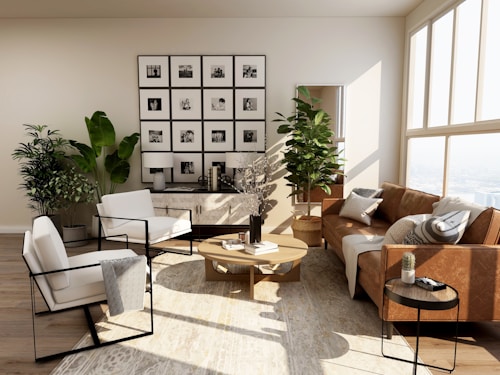
Living room with sofa and furniture

The living room

They discuss the sofa, television, a painting and some family photographs.

“The television is mine, but the photographs are ours.”

Kitchen with worktops and cupboards

The kitchen

They decide who will keep the coffee machine, the saucepan set and the everyday crockery.

“The coffee machine is yours. The saucepans are mine.”

Bedroom with bed and bedside tables

The bedroom

They sort out the bedside tables, a jewellery box and a collection of books.

“The jewellery box is hers. Those books are his.”

Study with desk and computer

The study

There is a computer, a printer and a number of work-related books and files.

“This computer belongs to me. The printer belongs to both of us.”

Tools and equipment in a garage

The garage

They have two bicycles, a toolbox and a lawn mower to divide between them.

“The bicycles are ours, but the toolbox is yours.”

Look at the grammar: The room vocabulary gives us something to talk about, but the key information is expressed through my, mine, your, yours, his, hers, our, ours and their, theirs.

Practice 1 – Adjective or pronoun?

Choose the correct word. Look at whether a noun follows the gap.

Practice 2 – Whose is it?

Read the information in each situation and choose the answer that identifies the owner.

4. The conversation

Read how David and Susan reach agreement as they go through the house.

Susan: Let's start with the living room. The television is yours, isn't it?

David: Yes, it's mine. You can have the painting. I know you like it.

Susan: Thank you. But the photographs are ours. I'd like us to make copies so that we can both keep them.

David: That's a good idea. Now, what about the kitchen? Is the coffee machine yours?

Susan: Yes. It was a present from my sister. The saucepan set is yours, though. You bought it.

David: All right. And the plates and glasses?

Susan: We bought those together. They're ours. We can divide them between us.

David: In the bedroom, the jewellery box is yours. The books on the bedside table are mine.

Susan: What about the computer in the study?

David: That belongs to me because I use it for work. But the printer belongs to both of us.

Susan: So it's ours. We can decide later who needs it more.

David: And the bicycles in the garage?

Susan: The blue one is yours and the red one is mine. We each bought our own.

David: Good. This is going better than I expected.

Susan: Yes. We don't agree about everything, but at least we can be fair to each other.

Notice: ours can refer to something shared by David and Susan. Mine and yours identify individual ownership. The same object can also be described using belong to.

Practice 3 – Understanding the conversation

Choose the answer supported by the conversation.

Practice 4 – Say it another way

Choose the sentence with the same meaning.

5. Discussion – What belongs to whom?

These questions can be used for individual reflection, pair work or class discussion.

A short speaking task

Imagine that you and a friend are moving into a shared flat. Decide who owns or will provide these things: a television, a kettle, a sofa, a computer and a set of plates.

Use the patterns:

“This is my television. It's mine.”

“The kettle belongs to you. It's yours.”

“The sofa is ours. We bought it together.”